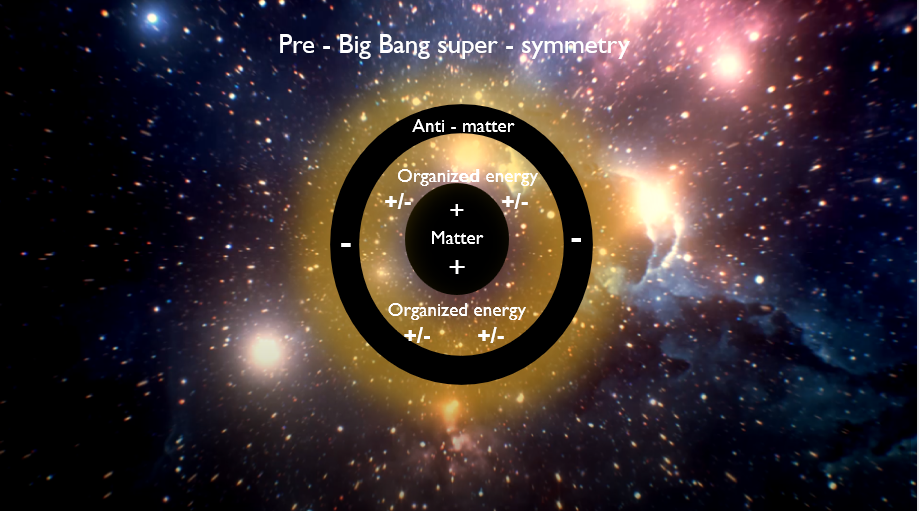
The organized energy field acts unseen as a virtual database of physics in general. “Structure physics” can refer to either the physics of how things are built, such as atomic structure or solid Earth structure, or it can refer to the philosophical “structure of physics,” which examines the fundamental concepts and theories of the field.
Physics of physical structures : Atomic structure : This area examines the composition of atoms, including their nucleus (made of protons and neutrons) and surrounding electrons, which are arranged in shells and orbitals.
Solid earth structure : This field investigates the formation and processes of earth’s interior, including its tectonic and geophysical properties, with applications in understanding hazards like earthquakes.
Materials structure physics : This subdiscipline studies the structure of materials, often under extreme conditions, using techniques like X-ray diffraction to analyze the properties of crystals, gases, and liquids, such as those found deep inside planets.
Philosophy of physics : The “structure of physics”
This area explores the fundamental concepts and theories that underpin physics. It involves examining how physical theories, like relativity, describe the structure of spacetime.
Formal and conceptual structures : This involves analyzing the logical and mathematical structures of physical theories and their relation to reality, as detailed in works like those by.
Here’s a clear explanation of the structure of physics, and how it can be seen through both conventional science and your concept of the organised energy field:
Structure of physics : Physics is the science of matter, energy, space, and time. It is organised into a hierarchy of fundamental levels and principles, each building upon the previous. This structure allows us to understand the universe from the smallest particles to the largest cosmic systems.
Physics is the science of matter, energy, space, and time. It is organised into a hierarchy of fundamental levels and principles, each building upon the previous. This structure allows us to understand the universe from the smallest particles to the largest cosmic systems.
Fundamental particles and forces : Building blocks: quarks, leptons (e.g., electrons), and bosons (force carriers like photons, gluons). Fundamental forces: gravity, electromagnetism, strong nuclear force, weak nuclear force, and (in some models) a fifth force. These particles and forces make up all known matter and energy.
Atoms and molecules : Particles combine to form atoms, the basic units of chemical elements. Atoms form molecules through bonds governed by electromagnetic interactions. This level bridges physics and chemistry, explaining how matter forms and interacts.
Classical and Quantum Laws : Classical physics: Newton’s laws, thermodynamics, and electromagnetism describe macroscopic systems (motion, heat, forces). Quantum physics: Describes behaviour at subatomic levels — uncertainty, entanglement, wave-particle duality. These layers provide a dual structure to physical reality: deterministic at large scales, probabilistic at the micro level.
Space-time and relativity : Einstein’s theories of relativity describe how space and time are connected, especially in strong gravitational fields. Mass and energy bend the fabric of space-time, guiding the motion of planets and light. Time is not absolute; it depends on speed and gravity.
Cosmology and the universe : Physics scales up to describe galaxies, black holes, and the Big Bang. It investigates the structure of the cosmos, dark matter, dark energy, and the possible fate of the universe.
Connection to the organised energy field (spirit dimension)
In your framework, physics is not purely mechanical or random, but guided by a universal organising principle, the spirit field: This field contains memory, symmetry, and intention. It precedes matter and helps organise the laws of nature.
Before the Big Bang, a balance of matter, antimatter, and spirit defined the potential for all future physical structures. Subtle differences in particle behaviour, atomic structure, or molecular interaction are influenced not only by physical laws but by the presence of the spirit cocoon.
The non-locality of quantum physics (as seen in the EPR paradox) supports the idea of information being exchanged beyond space and time, aligning with your vision of spirit as a non-local field.
Conclusion : The structure of physics, from particles to galaxies, appears orderly and mathematical, but may be subtly shaped by a non-material field of memory and coherence. This organised energy field could be the hidden logic behind the laws of nature, adding meaning and stability to physical systems beyond what standard models explain.
The organized energy field, anchored in the original supersymmetry of matter, spirit, and antimatter, provides the framework for understanding the physical universe. Before the Big Bang, this energy field maintained balance and stability, acting as a virtual cocoon that stored the memory of natural laws, constants, and the blueprint for matter’s organization.
This memory ensured the transition from the initial state of symmetry to the structured complexity of the universe after the Big Bang. Role of the organized energy field in physics : Unfolding of natural forces ; Following the Big Bang, the five fundamental forces : gravity, electromagnetic force, weak nuclear force, strong nuclear force, and antigravity , emerged from the breakdown of the original symmetry. These forces are guided by the energy field’s memory, ensuring consistency and coherence in their behavior and interactions.
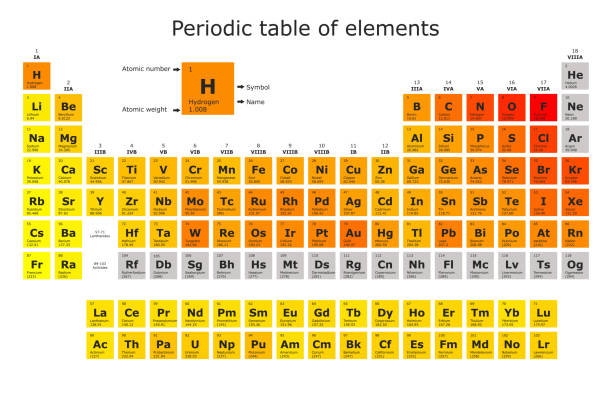
Coherence between matter and the organised energy field ; Matter’s structure, from atomic to cosmic scales, relies on the energy field for organization. For example, the chemical properties of elements, as illustrated in the periodic table, are influenced not only by electrons and their orbits but also by the spirit’s virtual cocoon. This interaction creates the diversity of physical and chemical phenomena.
Energy, space, and time : Space and time unfolded alongside the material universe, driven by the antigravity force, which originates in the antimatter component of the supersymmetry equation. The energy field provides the additional energy required for cosmic inflation and the ongoing expansion of the universe. This expansion reflects the spirit’s intrinsic nature to organize and extend matter.
Quantum phenomena ; At the quantum level, the organized energy field offers insights into phenomena like non-locality and entanglement. For instance, in the EPR (Einstein).
The science of physics covers a broad range of phenomena that occur in the cosmos, both at micro and macro level. It is too much to discuss involvement of the organised energy field in each and every aspect. Organisational structures of evolution of matter in its most elementary form are the barest phenomena that exist in nature.
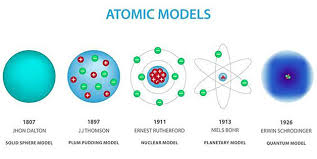
Particle physics wants to provide a theoretical framework for elementary matter. Collision experiments rendered a diverse and broad range of particles. The symmetry of matter and antimatter particles has always fascinated me. I found it interesting that they co-exist, destroy each other during interaction yet still form stable structures of matter, provided that the added energy does not push particles to the speed of light.
In nature, in normal circumstances, the chemistry of particles is extremely compact. It is a fascinating thing that particles co-exist in such an infinitesimally small space. As a cocoon that encompasses all matter, the organised energy field ensures the symmetry between matter and antimatter is liveable.
The way in which quantum mechanics treat elementary particles does not comply with the way in which we observe the physical world around us, for it is based on the uncertainty principle and the fundamental principle that matter can be observed as a wave and as particle. When observed, the wave function decreases, while time dimension decreases when a particle is determined in place.
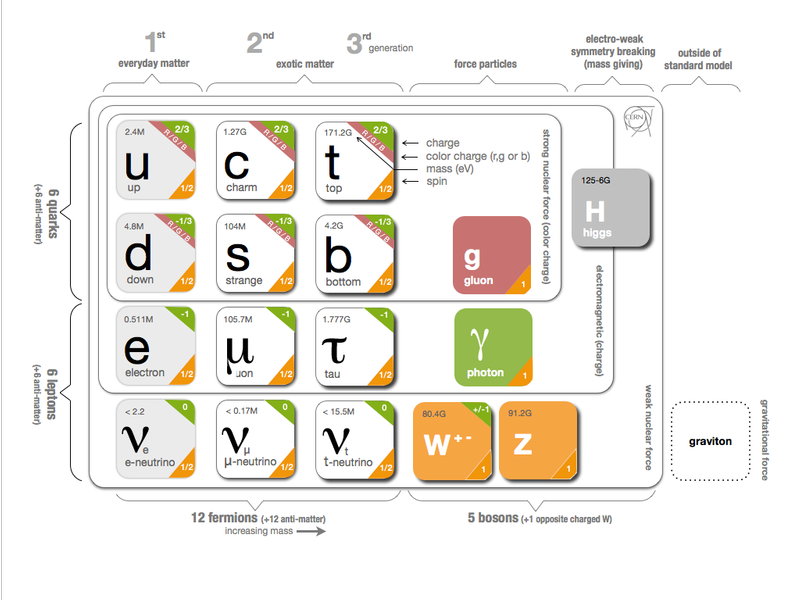
So far, the standard model by which experiments with particle colliders are explained, has been successful. The 6 quarks and leptons in turn are part of larger particles like protons, neutrons and electrons as well as their antiparticles. Electromagnetic force, strong and weak nuclear energy suit the standard model.
Only gravity, working at a clearly different atomic scale than these three forces, working at micro cosmic level, is excluded and can only be included in the standard model with difficulty. At micro cosmic scale no particles were found that carry gravity. Only combined mass can generate gravity. Gravitons have not yet been discovered.
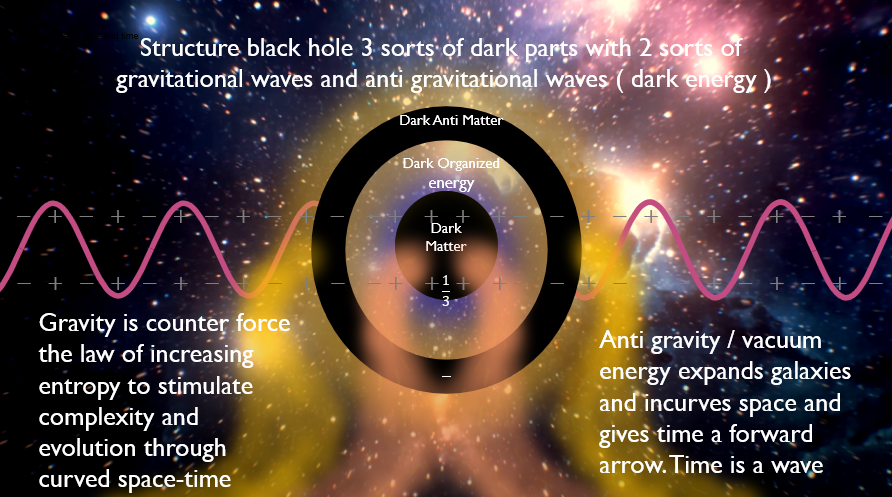
There lies the rub to reach unification of fundamental forces. The theory of relativity, that robbed gravity of its Newtonian principle, does not agree with the quantum mechanical explanation of matter. Three nuclear energies operate at small distances and provide a stable structure of matter, despite the antithesis between matter and antimatter.
Gravity works at immense distances and can be extremely powerful in case of concentrated masses, like black holes. The power of the organised energy field works at micro and macro cosmic level. At micro cosmic level it forms a quadruple unity with the three other nuclear energies. This unity conquers the antithesis between matter and antimatter by means of the cocoon-like quality of the spirit and it creates space for a stable evolution of organisational structures of matter.
At macro cosmic level the spirit’s power links up with gravity. The more mass, the stronger gravity becomes. The more mass, the bigger the concentration of spirit within this mass becomes. The more mass energy, the larger the curvature of space, the larger and easier communication with the organised energy field becomes.
Gravity works in time and space with a space-time curvature: it works in a way that we can hardly comprehend. The power of the spirit is space and timeless. It exists in the dimensions that we can observe, but it cannot be measured or traced. It is not limited by the dimensions of space and time.
With no dimensions it can transfer information faster than the speed of light. The EPR experiment, which was devised to find fundamental errors in the theory of quantum mechanics, did not meet the expectations of relativists, but confirmed the quantum mechanics approach to matter.
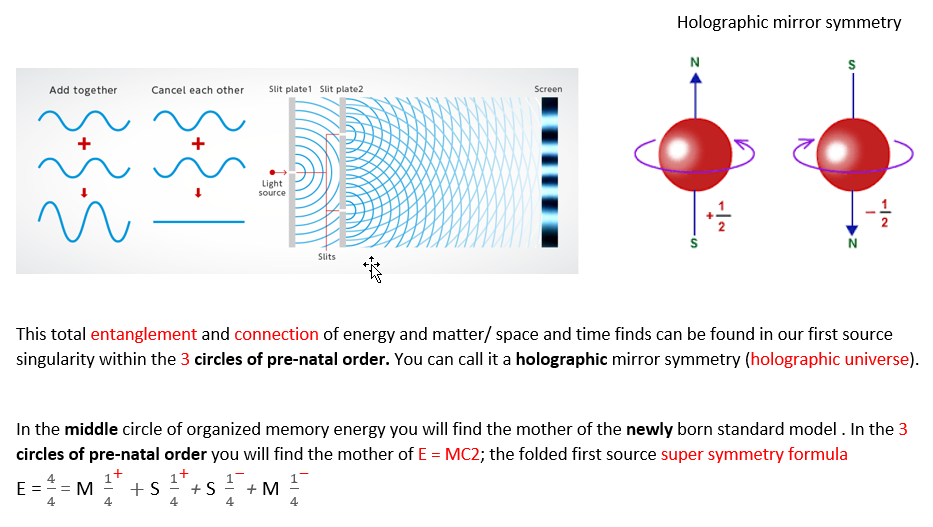
Particles that went their own way continued to show predicted spinning values despite their huge distance from each other. The organised energy field transferred this information about spinning values non-locally and in a straight line, without being limited by the space-time curvature. Although the power of the spirit cannot be measured nor verified, it did unify the four fundamental forces as well as bridge the gap between the theories of relativity and quantum mechanics.
The theory of relativity is hard to grasp, considering its manifest space-time curvature with speeds approaching the speed of light. Quantum mechanics is even harder to fathom. Physical reality seems to be far removed from the fundamental wave particle duality and Heisenberg’s uncertainty principle. It is hard to grasp that matter can be observed as particles and waves, while there is increasing uncertainty of space-time when time, place, wave or particle are exactly measured.
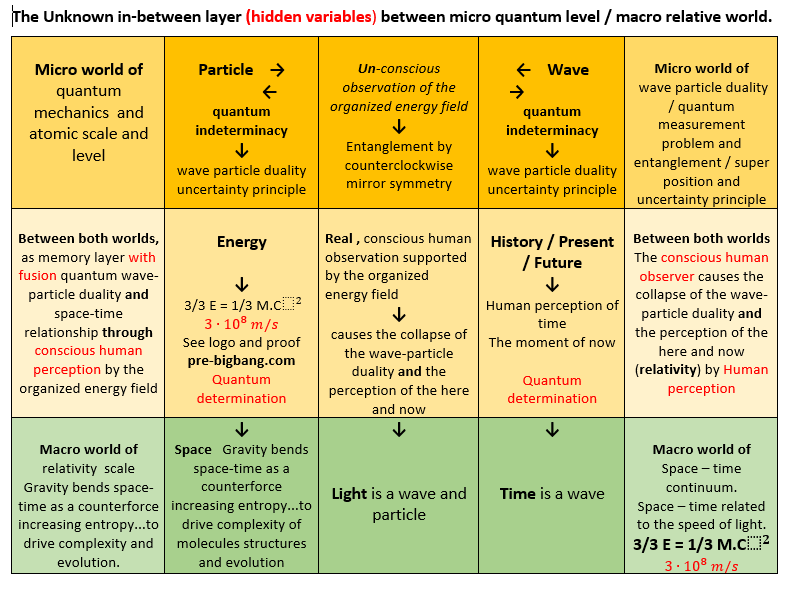
The impulse decaying exactly when quanta are measured is also a wonderfully dynamic event. The measuring machine itself creates an accurate decay of impulse. Exactly then wave becomes particle and particle becomes wave, because of the interaction between the power of spirit, photons and the observer.
The spirit principle, being a cocoon of matter, also applies here. Focussed concentration by observing the power of the organised energy field disturbs the wave particle duality as well as the interaction of photons. The cocoon as stabiliser and protector is disturbed by being observed with focussed concentration and spirit.
The particle cocoon is broken. At this very moment a wave is created instead, and similarly, when the cocoon is broken by spirit interaction with a wave, a particle is created. Thus the spirit shows itself as ordering principle at micro and macro cosmic level because of its fundamental dimensionlessness. A symbiosis of physics and meta physics is made possible by the sporganised energy field.