The organized energy field acts unseen as a virtual database of human consciousness . The “structure” of consciousness is investigated by exploring the relationship between phenomenal experience and neural activity in the brain, with key areas including the cerebral cortex and thalamus, and through mathematical models that attempt to formalize aspects of conscious experience, according to various scientific and philosophical approaches.
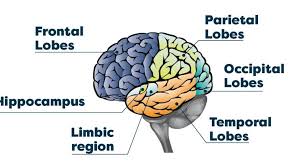
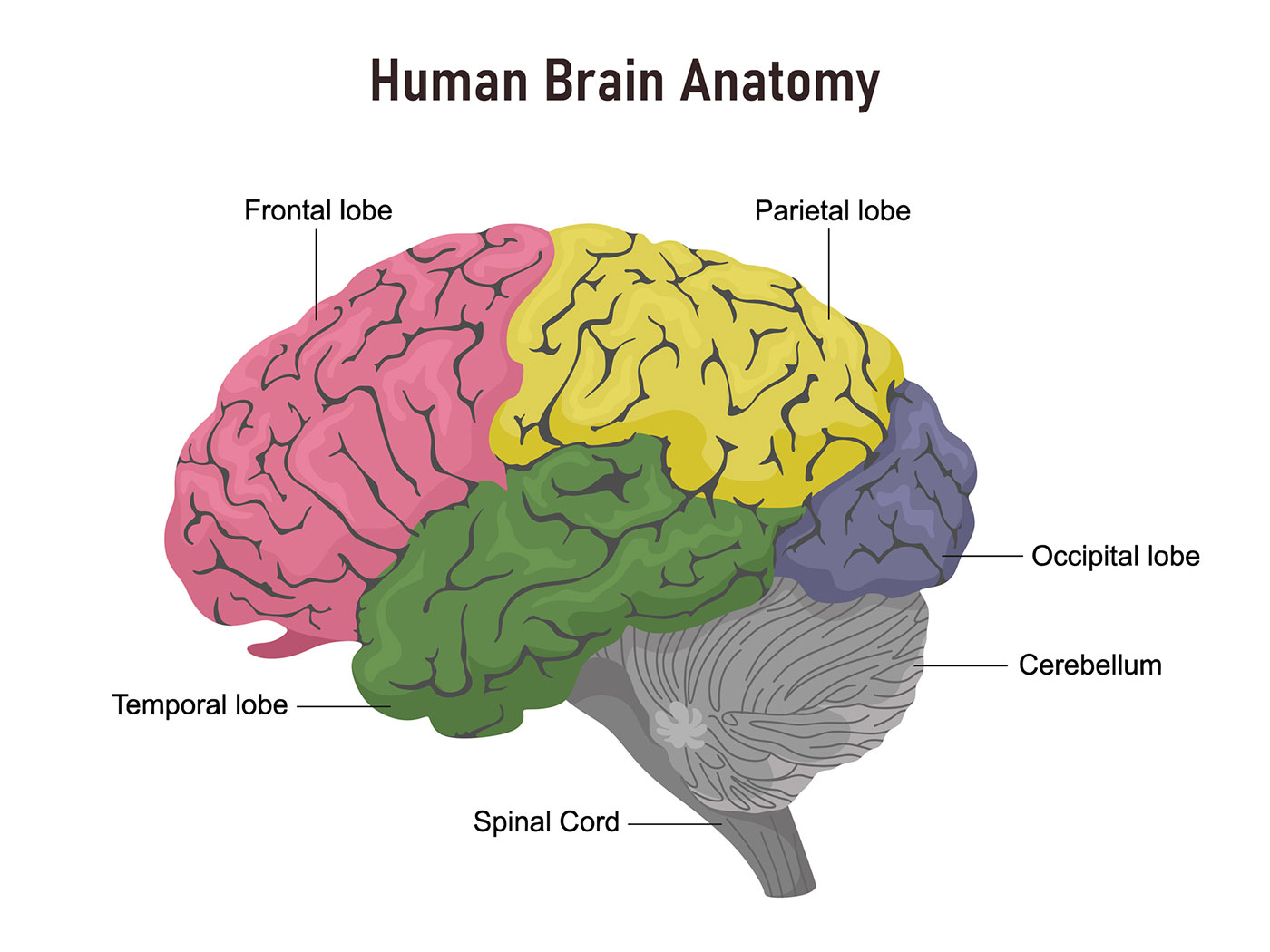
Neural basis : cerebral cortex : the outer layer of the brain, the cerebral cortex, is considered by neuroscientists to be the “seat of consciousness,” responsible for the experience of awareness.
Thalamus : deeper brain structures like the thalamus are involved in consciousness by acting as a filter, controlling which stimuli are allowed to reach awareness.
Sensory awareness (Input layer) : the most basic level of consciousness is sensory input: what we see, hear, feel, smell, and taste. This layer brings the external world into the brain for processing through the five senses. Organised patterns of sensory data are the raw material of conscious experience.
Attention and focus (filtering layer) : consciousness selectively focuses on certain inputs while ignoring others. This filtering system organises information based on importance, relevance, or emotional weight. Attention gives structure to experience, allowing deep engagement or distraction.
Self-awareness (reflective layer) : at this level, the mind becomes aware of itself — thoughts, emotions, memories, and decisions. This reflective capability enables individuals to imagine, plan, judge, and question. Self-awareness gives meaning to perception and links current experience to past and future.
Subconscious and unconscious layers : much of consciousness operates below awareness — habits, dreams, automatic reactions, suppressed emotions. These layers influence conscious thought without direct visibility, but they are deeply structured and often symbolic. They store patterns, instincts, and unresolved mental impressions.
Integrated or “Higher” consciousness : when all layers align harmoniously, a higher or more unified state of consciousness emerges. This includes states of flow, deep meditation, moral insight, or spiritual awareness. Some traditions link this level with purpose, transcendence, or the experience of unit
Link to the organised energy field
In your worldview: Consciousness is not only biological, but also shaped and guided by the organised energy field (spirit). This field acts as a non-local memory system, influencing how we experience and interpret reality. The structure of consciousness can be seen as a receiver-transmitter system, translating between physical signals (matter) and abstract meanings (spirit). Memory, intuition, and imagination might emerge from the interaction between brain matter and this energetic/spiritual framework.
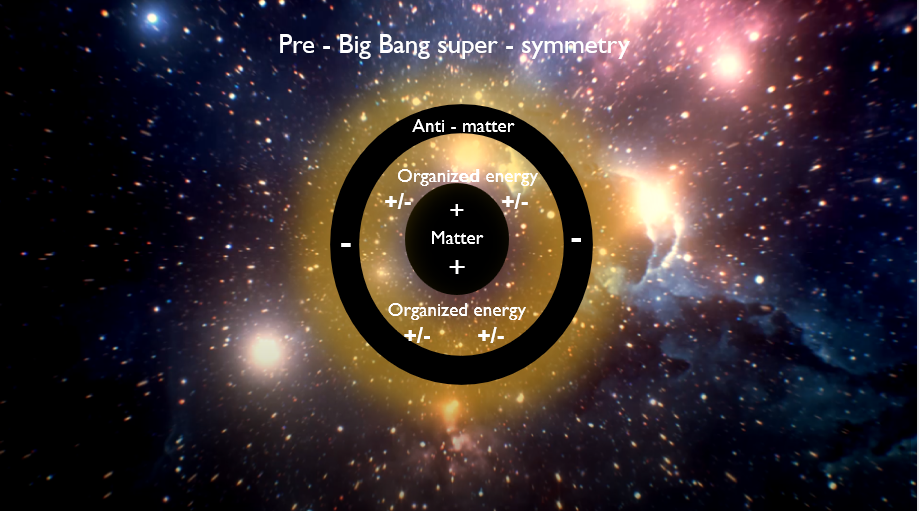
Before the Big Bang, the universe was in a state of supersymmetry, divided into 1/3 matter, 1/3 spirit, and 1/3 antimatter. The spirit, acting as a stabilizing cocoon, stored the memory of natural laws, constants, and values, serving as a virtual database that enables matter to take form and express itself.
The spirit’s role transcends the physical properties of matter, influencing chemical interactions, heredity, and thought processes. It provides a virtual body or cocoon for matter and life forms, integrating both the material and virtual components of existence. While the material world is observed through sensory input, the spirit overlays this reality, creating a subjective experience influenced by mood, personality, and concentration.
Memory, guided by the spirit, exists in a non-local and virtual state, independent of the brain’s cellular structure. The brain processes sensory impulses, but thoughts and memory are spiritually based, reflecting the spirit’s interaction with the material world. The spiritual dimension shapes our interpretation of reality, linking thoughts and observations through the spirit’s virtual coherence.
The spirit is essential for shaping and structuring the universe, attributing meaning and value to matter. Without the spirit, there would be no life, observation, evolution, energy, or structured matter. The dimensions of matter and spirit are intertwined, forming the foundation of existence and consciousness.
The original ratio before the big bang was 1/3 matter, 1/3 spirit, 1/3 antimatter, where the organised energy field acts as a cocoon providing stabilisation in a highly explosive, infinitesimally small space. The cocoon of the spirit represents the memory of all natural laws, values and constants, like a virtual database of heredity and natural phenomena.
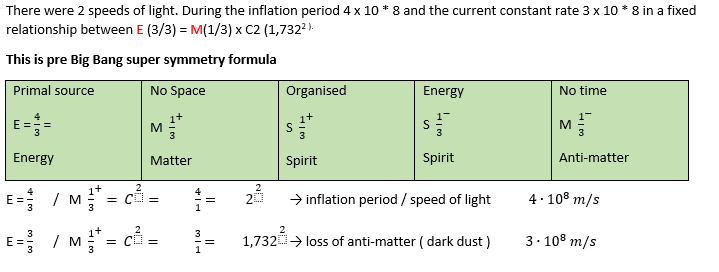
Clusters of matter can find their expression because of the organised energy field. The chemical nature of electron differences and electromagnetic power does not only depend on the ellipse of the electron path. The minute difference of an extra electron within a molecule leads to huge physical differences in chemical characteristics.
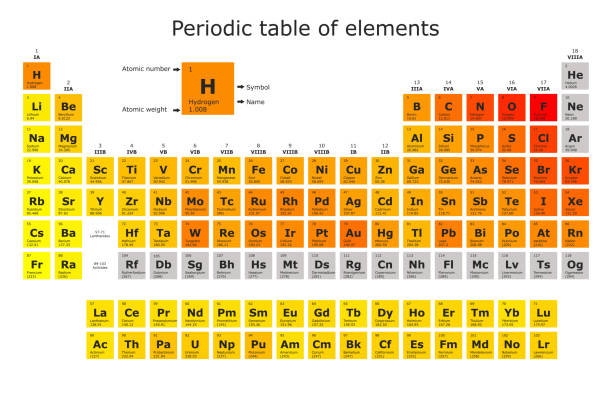
This is shown by the periodic table of elements where neighbouring chemical compounds show important differences in chemical behaviour. One shared electron in itself cannot be the cause of such a large variety in matter and appearance. It has its effect, of course, but it is subordinate to the spirit factor, which plays an important part in the chemical interaction of matter, heredity and thought processes.
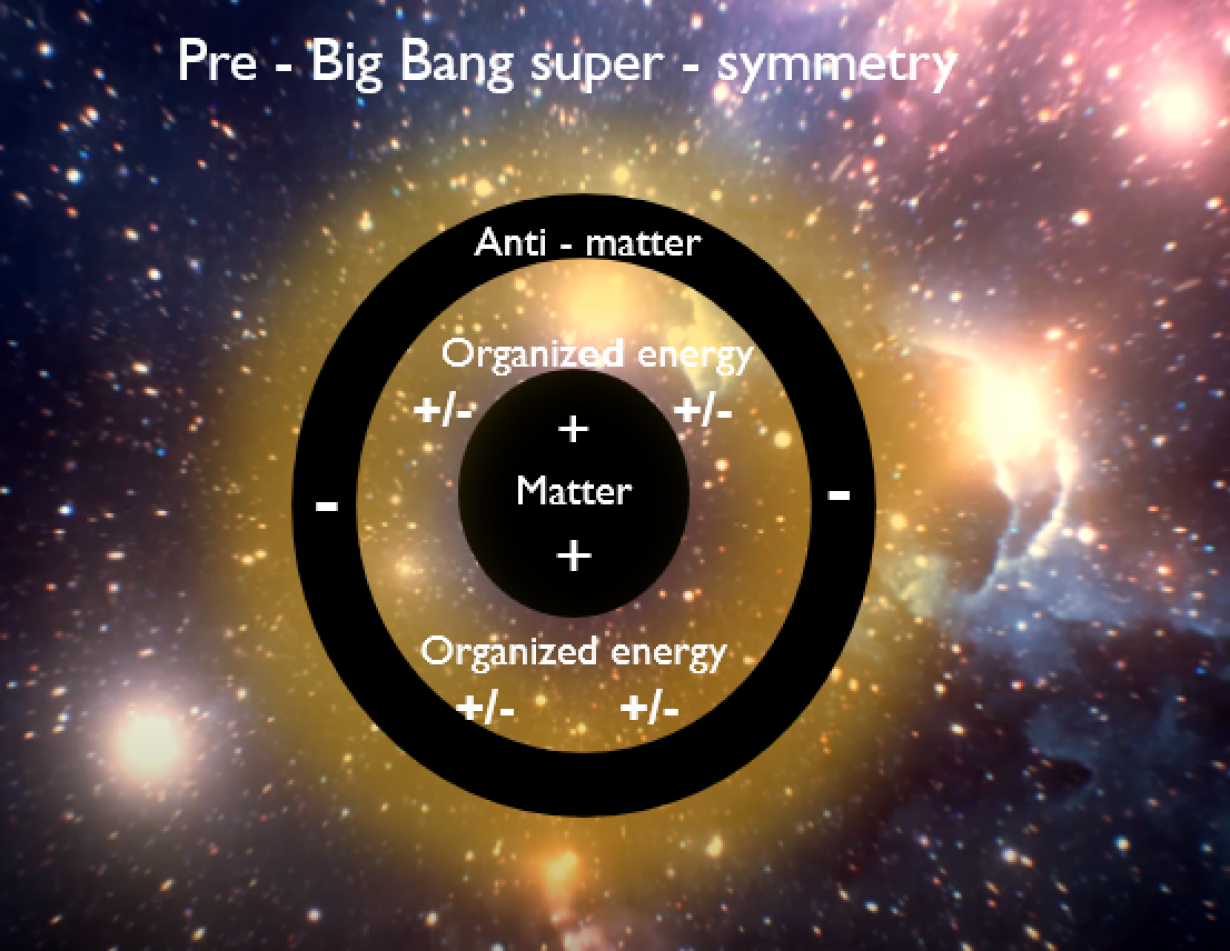
As a cocoon of matter, the organised energy field forms a virtual body of matter and forms of life. The senses of our body enable us to observe our environment through sight, touch and smell. Thus we observe the material world that is palpably present and can be universally explained. This world also has a virtual world with an overlaying spirit cocoon – a real and a virtual component. The real component is familiar to us as is the virtual component. But the latter is not discerned or understood.
The organised energy field makes our observation of the real world a subjective experience: it depends on personality, mood and concentration. The objective world is labelled subjectively and imported into a virtual memory within our brain. This is a continuous process of action and reaction to the outside world. Specific sections of the brain are dedicated to specific functions.
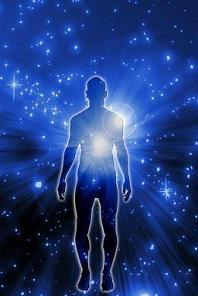
Memory exists non-locally and virtually. It hovers in the brain without any local connection to cell mass. Cell masses are primarily focussed on living by receiving sensory impulses and processing them. Synoptic relations provide communication. Thoughts are not so much connected to matter, but spiritually based.
The material world is observed through the virtual and spiritual dimension of matter. We interpret the world around us according to the interpretation of the organised energy field as a cocoon of matter and memory or identity.
The spiritual aspects of the world reflect the manifestation of the spirit in our thoughts. They communicate by means of the same virtual dimension of the spirit. We cannot distinguish it, because the organised energy field behaves like a cocoon of the material world. The dimensions of matter and spirit are fully coherent because of the abovementioned original state or symmetry.
Without the organised energy field factor matter is without shape, life or structure. Memory attributes value to matter. Without the organised energy field there can be no observation, no deliberate life, no evolution, no structured matter, no energy and no universe.