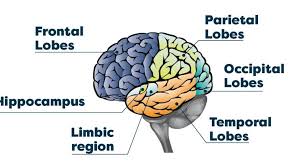
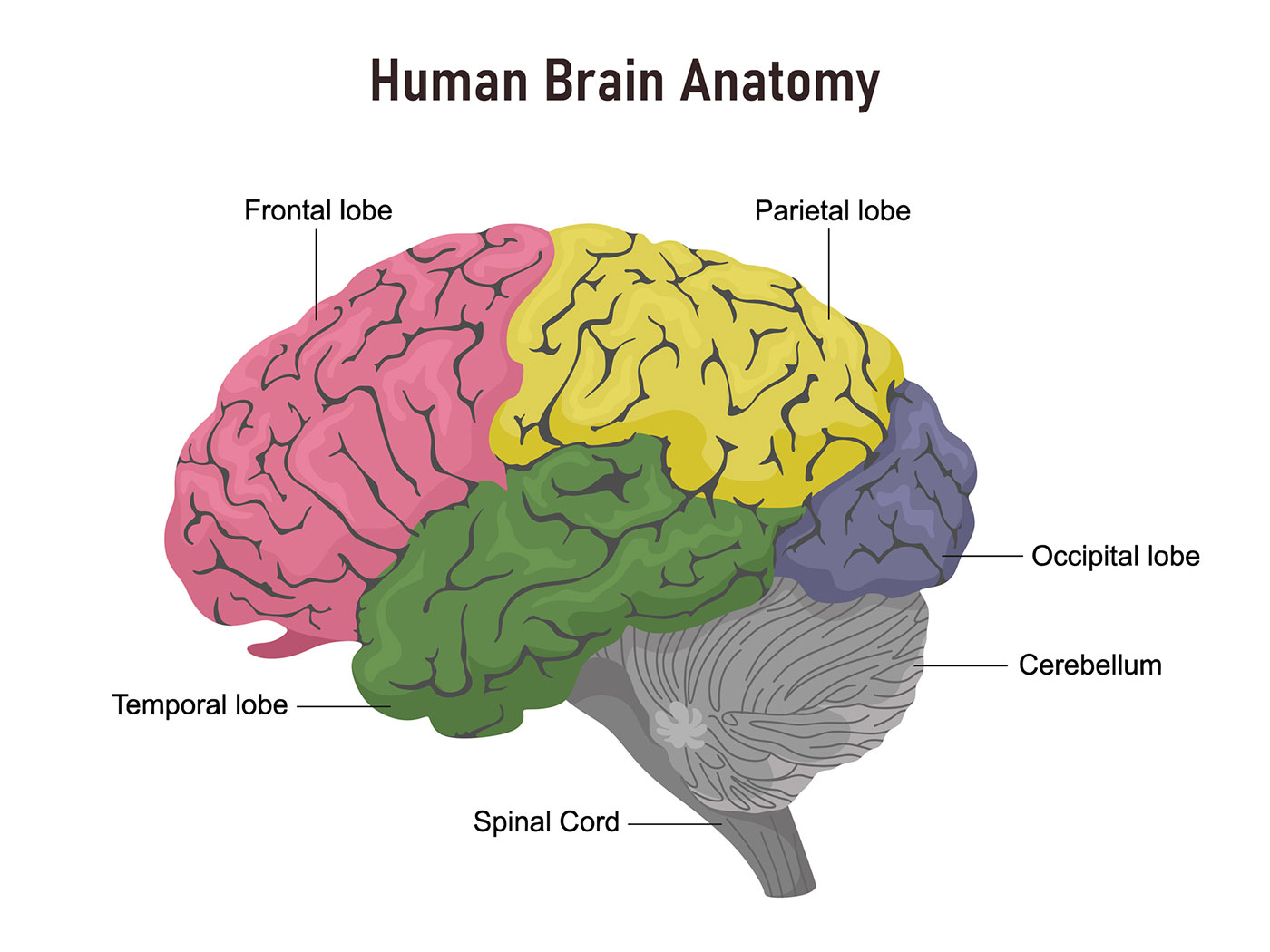
Memory in the brain is not localized to one area but rather relies on the coordinated activity of interconnected brain regions. Different types of memories are stored in different parts of the brain. The hippocampus is crucial for forming new memories, particularly explicit memories (facts and events) and is part of the temporal lobe.
The cerebral cortex, especially the prefrontal cortex, plays a key role in short-term memory and working memory. The amygdala, located near the hippocampus, is involved in emotional memories. Implicit memories, like motor skills, are processed in the basal ganglia and cerebellum.
Key brain regions and their roles in memory: Hippocampus: essential for forming new memories, especially explicit memories (facts and events) and spatial memories. Temporal lobes: the temporal lobes, which contain the hippocampus, are involved in processing sensory information (including auditory and visual) and play a role in both short-term and long-term memory.
Cerebral cortex (neocortex): the neocortex, the outer layer of the cerebrum, is involved in storing long-term memories, both explicit and implicit.
Prefrontal cortex: this area is crucial for working memory, which is a type of short-term memory that allows you to hold information in mind while performing tasks.
Amygdala: the amygdala is involved in processing emotions and emotional memories.
Basal ganglia and cerebellum: these regions are important for the formation and storage of implicit memories, such as motor skills and habits.
Memory formation and storage: Synaptic plasticity: memories are thought to be stored by strengthening or weakening the connections (synapses) between neurons. This process is called synaptic plasticity. Consolidation: the process of converting short-term memories into long-term memories is called consolidation, and the hippocampus plays a key role in this process.
Reactivation: when you recall a memory, you are reactivating the specific group of neurons that were initially involved in forming that memory.
Organization: memories are not stored in a random fashion, but rather in an organized manner. For example, associative memory involves linking related pieces of information together.
Here’s a structured explanation of the organisation of brain and memory in relation with the organised energy field:
Brain as biological processor The brain acts as the material interface between body, consciousness, and environment. Neurons and synapses organise impulses into networks of activity (electrical and biochemical). This creates the short-term working memory that allows attention, decision-making, and moment-to-moment awareness.
Memory layers in the brain Short-term memory (STM): immediate, fragile, biochemical–electrical patterns. Long-term memory (LTM): stable patterns reinforced by repetition, emotion, or learning. Stored through synaptic plasticity. Procedural memory: automated behaviours and skills. Emotional memory: stored with hormonal “tags” that make them powerful triggers.
Connection with the organised energy field The brain alone would suffer from biochemical decay, so memory needs a higher-order structure. The organised energy field (spirit cocoon) provides a non-local, timeless storage system: Neural activity generates number-like codes (patterns of energy) that are “uploaded” into the field. These codes remain preserved beyond physical changes in brain tissue. Memory is thus dual-layered: Local brain storage (neural networks, biochemical states). Non-local field storage (organised energy field as universal memory).
Retrieval and perception When recalling, the brain “queries” the organised energy field. Neural firing patterns resonate with stored field codes, allowing reconstruction of past experiences. Subjectivity arises because retrieval is filtered through mood, personality, and focus.
Organisation principles Encoding: sensory input → neural impulse → energy code in the field. Storage: dual system (brain = local, field = universal/non-local). Retrieval: resonance between brain signals and field patterns. Integration: perception = brain’s biological filter + spirit’s timeless memory.
Implications Explains why long-term memory survives despite brain decay (e.g., in aging, trauma, or near-death experiences). Provides a bridge between neuroscience and spirituality, where memory is not just chemistry, but also energy field resonance. Suggests that identity (self-consciousness) is stored not only in the brain, but also in the organised energy field, ensuring continuity beyond physical life.
Summary:
The brain organises memory locally through neural networks, but its stability and depth come from interaction with the organised energy field. This field acts as a universal database, storing encoded experiences beyond biochemical limits. Perception, learning, and self-consciousness arise from the interplay between biological processes and non-local energetic organisation.
Memory, reality, and brain touch by organized energy field
Memory is a multidimensional phenomenon that cannot be fully understood by reducing it to biochemical or technical elements. It is timeless and dimensionless, intertwined with the human spirit and consciousness. Scientific inquiry provides the most promising avenue for understanding this complex process, although current knowledge still offers only a partial view of how the brain coordinates complex behaviors and stores memories.
The brain’s functional mapping The brain’s functionality and the coordination of its parts have been extensively charted. Impulses are transferred via synapses and neurotransmitters, which carry electric pulses of the nerves to various brain parts, enabling appropriate responses. The senses—touch, light, sound, and smell—are gateways to the outside world, allowing the brain to process signals and respond reflexively or store them as lasting memories.
The nature of memory Memory is an impression of reality composed of sensory signals such as sound, light, smell, emotion, and touch. Insignificant events are typically remembered only briefly, but significant experiences are retained longer. What determines significance and the process of storage and retrieval is complex and subjective.
The role of number sequences Every observation is a reflection of the spiritual cocoon that enwraps all matter, represented as a sequence of imaginary numbers. These sequences are continuously entered and stored in the brain via the senses. Recognition of events is triggered by common number sequences, which serve as keys to previously stored information. The extent of concentration and emotional attachment determines the vividness of a memory.
Subjective interpretation of reality Objective reality is translated into number sequences, which are then subjectively interpreted and labeled through personal awareness. Human personality and self-awareness, remnants of previous lives, influence personal choices and behavior, making objective reality personal. Negative observations are stored in the subconscious, while positive ones are labeled for easy retrieval. During sleep, stored number sequences are screened for their long-term usability, with significant ones stored for future interaction and less useful ones relegated to deeper memory or the subconscious.
Memory formation and development Memory formation is influenced by upbringing, education, and environmental interactions, enhanced by self-awareness and language development. Early childhood memories are sparse because the ability to label and store number sequences is not fully developed. As individuals grow and learn, their memory capabilities expand, shaped by continuous sensory observation and personal experiences.
Routine and new memory information Routine matters are etched into behavior patterns, much like an automatic pilot, and do not contribute significantly to the existing memory file unless significant changes occur. Brain damage, such as from a stroke, can impair memory processing, affecting the ability to create new memories while preserving old ones.
Memory and self-awareness Memory is intertwined with self-awareness and the spirit. It is not a static data bank but responds to both internal desires and external information. The spirit, a timeless and dimensionless cocoon, interacts with the brain’s organic matter, influencing thought and behavior through imaginary number sequences. Brain damage can disrupt this interaction, affecting memory and function.
The spirit’s role in memory and creativity The spirit, or self-awareness, is capable of imagination and creativity, independent of memory. It can create art, music, and fantasy, demonstrating an ability to reshape the environment beyond mere observation and reaction. This capacity is part of our collective memory and inherited spiritually, suggesting a morphogenetic field.
Conclusion Memory is a complex interplay of biochemical, neural, and spiritual processes. It involves the continuous flow and interpretation of sensory data, influenced by personal awareness and creativity. Understanding memory requires acknowledging its multidimensional nature, integrating scientific knowledge with an appreciation of the timeless and dimensionless aspects of the human spirit. This holistic view recognizes that memory is not merely a biochemical process but a dynamic interaction between the brain, consciousness, and the organized energy field of the spirit.
The organised energy field and the Cognitive Process
The phenomenon of memory, as it is known to mankind and which makes life valuable, cannot be dissected reductionistically into its composing elements. The human memory is timeless and dimensionless too. It is too limited to try and unravel the human memory in purely biochemical or technical terms. The only right way to gain insight in this unique phenomenon is the scientific way.
The brain has been charted quite well, as to its functionality. The way in which different parts of the brain cooperate has also been mapped out by tracing impulses. How parts of the brains are coordinated, resulting in the complex behaviour of human beings, can still be fathomed only to a small extent.
Impulses are transferred by means of synapses and neurotransmitters, carrying the electric pulses of the nerves, transporting them slower or quicker to other parts of the brain so proper action can be taken.
The senses are responsible for contacts to the outside world. Signals acquired through touch, light, sound and smell find their way to the brain where they can be processed for response. This all happens quickly and adequately where reflex responses are concerned.
Apart from instigating a response, a signal can also cause a lasting effect in the memory. This process is difficult to trace in the brain. For, what actually is a memory? It is an impression of reality in sound, light, smell, emotion and touch.
An observation usually is composed of a mix of sensory signals. Matters that are insignificant will be remembered for some days at the most and then disappear, apparently. But who judges what is significant and what is not? What is worth being retained? How is it stored and how can a memory be retrieved?
Every observation of reality around us represents a reflection of the spiritual cocoon that enwraps all matter. This cocoon is a number sequence, which reflects relations within matter. This sequence of imaginary numbers is continuously entered and stored in the brain through the senses.
Whenever an event occurs that has bearings on or references to information that was stored in the past, it is recognized by a common number sequence, which functions as a key to offer access to previously stored information.

The memory is retrieved and recognised. The extent of concentration and emotion attached to the event determines the vividness of the memory. The objective translation of reality in a number sequence is subjectively picked up and labelled through personal awareness.
This entity can lend a personal touch to the objective reality. The human personality and self-awareness has been sitting in the brain from birth as a remainder of previous lives. It influences the personal choices and behaviour of human beings.
It determines whether someone is open to different forms of reality. The objective reality is made personal through self-awareness. Negative observations are avoided and stored in the subconscious.
The number sequences is damaged to make retrieval harder. Positive observations are labelled so they can be easily retrieved. Processing large waves of number sequences is a continuing process. When awake, the brain stores number sequences continually. When asleep, stored number sequences are judged by their importance in the long term and the short term.
The values are screened as to their usability through dreams. Useful observations are stored in that part of the brain that is easily applied to interaction. Less useful observations will be stored deeper in the file. Useless observations end up in the subconscious. A human being is put on earth as a helpless organism.
Nurture and education teaches it how to observe, as a tool to understand reality and act accordingly. These processes of learning, combined with the original self-awareness and personality make up its subjective observation of reality.
This skill is not yet developed in early childhood. The number sequences of reality cannot yet be labelled and so end up in the subconscious. That is why young children hardly remember anything.
The ability to remember is further developed by living, education and contacts with the environment and it is made personal by self-awareness. Language also plays an important part. It is not developed sufficiently at a young age to attribute names to events.
Data permanently flow to the brain in highs and lows by means of sensory observation. A lot of information stems from daily routines and fixed activity schedules. Memory of routine matters is etched into a pattern of behaviour like an automatic pilot. The information sequences of familiar situations are impressed upon the memory, but they do not add to the existing memory file.
Only when a fellow human being, for instance, has been absent for quite some time or has undergone a metamorphosis, new memory information is stored and old data is modified.
Some people have suffered damage to the brain, which impaired their short-term memory or long-term memory, or both even. A stroke seriously damages the short-term memory, often used to act in domestic and other matters. People have to write down what they need to do, while the long-term memory still works.
Living in the present does not contribute anything to the long-term memory, because the brain has been damaged. The brain can no longer process the flow of numbers sustainably. Sensory observations and the observer’s personal touch are stored in the brain. But how? The human body renews itself completely several times during a person’s life. But memory stays the same, although it is affected by self-awareness during observation.
A memory can also be changed later, because of the influence of relevant information from external parties or by oppression from self-awareness itself. Memory is not a static data bank from which data can be retrieved whenever an opportunity occurs. Memory responds to internal (imaginary desire) and external information.
It is hard to imagine a purely biochemical and mechanical view of memory. However, there is interaction with hardware, but it does not happen in a scientifically verifiable way. The spirit is timeless and dimensionless and always present as a cocoon of all matter. But it cannot be localised.
Nerves send impulses to each other and muscles to encourage adequate thoughts and acts. The spirit hovers in the brain mass and is not divided in parts or cells. The spirit can manipulate brain activity biochemically through interaction. The brain, organic matter, is organised according to the spirit’s imaginary number sequences and it is made to accelerate pulses or slow them down by means of observation and imagination. See evidence part 2 in my book.
An autonomous action is followed by a reaction; such a pattern without spirit is like a system without learning abilities, intelligence and memory. As an intermediary between synapses and axioms, the spirit influences behaviour through imaginary number sequences. This logistic process, hard to imagine, is coordinated by an indivisible and dimensionless spirit, omnipresent in its entirety.
Brain damage can be seen as faulty hardware. The software, i.e. the spirit, cannot intervene in the train of thought because of this fault. Certain nerve connections do not work and cannot process impulses, resulting in loss of function. The human body continually renews its cells, but memory remains and is not lost through cell deterioration. Memory, then, has to be separate from organic matter.
Self-awareness has the capacity to imagine and desire. Art is a striking example: a completely new world is created from nothing. Memory is not required to create art, music or phantasy. Creativity is a unique quality of renewed human behaviour. Self-awareness, or spirit, is not only a mechanism controlling pulses. It can create abstract thought and fantasy as an autonomous process within reality.
This capacity provides the spirit with the active means to reshape the environment, apart from the observation of the objective environment and the action-reaction-stimulus model. This capacity is universally inherited and part of our collective memory through the ages. Considered spiritually, it is a sort of morphogenetic field.
https://pre-bigbang.duckdns.org/einstein-said-gravity-is-not-a-force/