Perception and memory are intricately linked and constructed by the brain, shaping our understanding of reality. The brain doesn’t passively record information but actively constructs perceptions through a combination of sensory input (bottom-up processing) and prior knowledge, expectations, and memories (top-down processing). These processes involve various brain regions, including the parietal lobe for spatial perception and the hippocampus for forming contextual memories.
Here’s a breakdown of the key aspects:
Perception and reality construction: Sensory Input: light, sound, and other stimuli are received by sensory organs and transformed into neural signals that travel to the brain. Bottom-up processing: the brain interprets these signals based on their inherent characteristics (e.g., color, shape, sound).
Top-down processing: prior knowledge, expectations, and existing memories influence how we interpret sensory information, potentially leading to different perceptions of the same stimulus.
Examples: a familiar object might be recognized more quickly due to top-down processing, while illusions demonstrate how the brain can create perceptions that differ from objective reality.
Memory and reality: Memory Systems: different types of memory (episodic, semantic, working memory) rely on distinct brain regions and mechanisms. Hippocampus and temporal lobe: the hippocampus plays a crucial role in forming new memories, particularly episodic memories (memories of specific events).
Memory as a construct: memories are not exact replays of past experiences but rather reconstructions based on stored information and current context, making them susceptible to distortion and biases.
Influence on perception: familiarity with objects or situations can enhance perceptual processing and even alter how we perceive things.
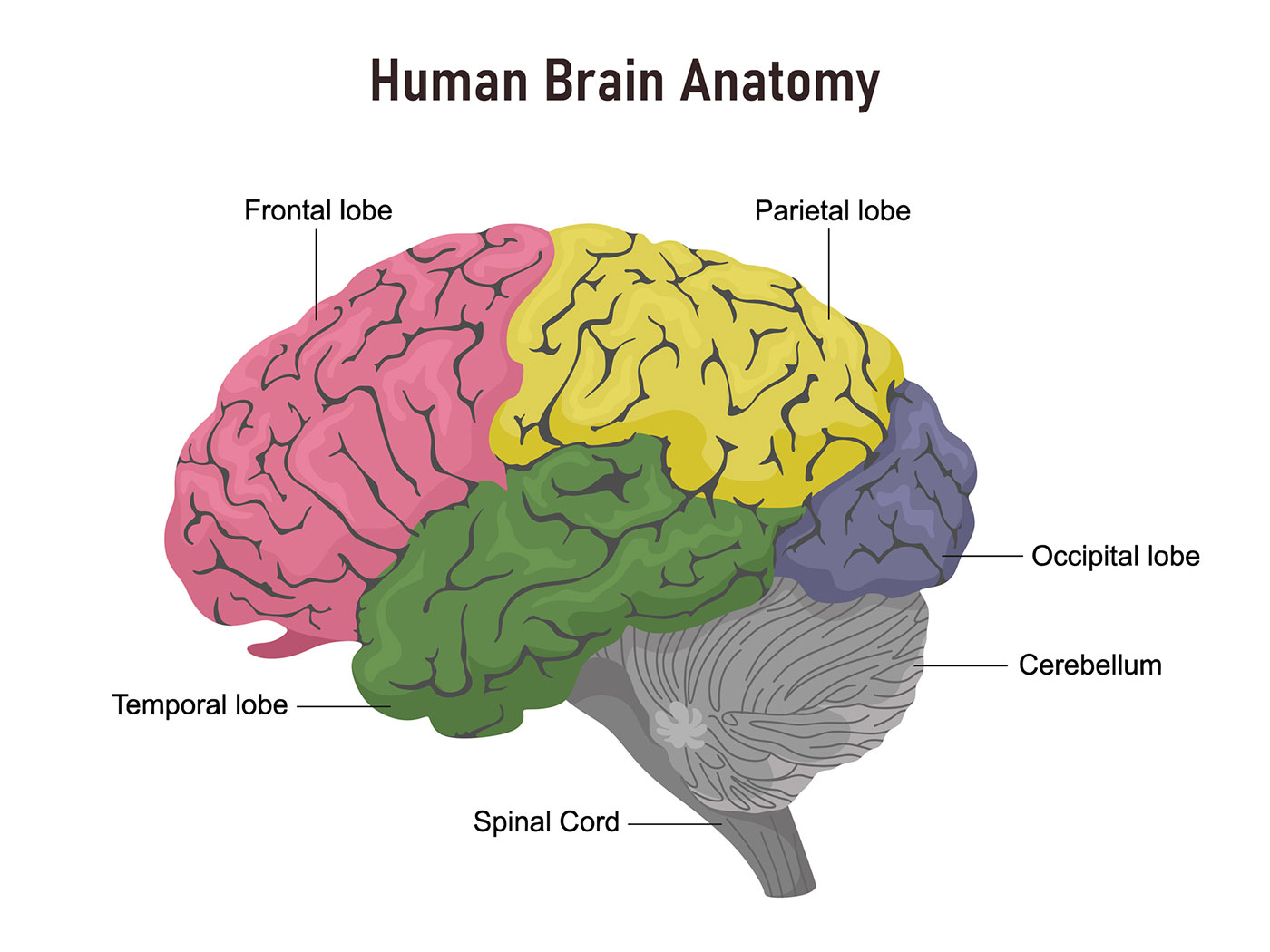
Brain structures involved: Parietal lobe: involved in spatial perception and constructing a sense of reality, particularly in relation to our bodies and surroundings. Temporal lobe (including Hippocampus): crucial for memory formation, storage, and retrieval.
Visual cortex: processes visual information, with different areas specialized for object recognition, spatial perception, and other visual attributes.
Prefrontal cortex (PFC): plays a role in cognitive functions like strategic memory, semantic memory, and working memory, influencing memory formation and retrieval.
Interactions and implications: Emotion and memory: emotional experiences can significantly impact memory formation, with strong emotions often leading to more vivid and enduring memories. Stress and memory: moderate stress can enhance memory, while extreme or chronic stress can impair memory function.
Time perception: the brain can perceive time in non-linear ways, with certain experiences like trauma or deep meditation distorting our sense of time.
Consciousness and memory: consciousness and awareness play a role in memory processes, but some aspects of perception, decision-making, and action can occur before conscious awareness.
In essence, the brain actively shapes our perception of reality by integrating sensory information with existing knowledge and memories. This process involves complex interactions between various brain regions and is influenced by factors like emotion, stress, and individual experiences
Here’s a structured explanation of organisation of perception and reality with brain and memory in relation to the organised energy field:
Sensory input and brain processing ; the brain receives sensory signals (sight, sound, touch, taste, smell) that represent fragments of the external world. These signals are translated into neural impulses and processed in specialised brain regions (e.g., occipital lobe for vision, auditory cortex for hearing). This organisation creates a coherent perception of reality, but it is already filtered and incomplete.
Memory and interpretation ; short-term memory holds sensory impressions briefly; some are stored in long-term memory depending on emotional intensity, relevance, or repetition. Memory acts as a reference system: new perceptions are compared with stored experiences to judge meaning, significance, and response. The result is not purely objective reality, but a subjective construction shaped by memory.
Organised energy field connection ; the organised energy field (spirit/memory cocoon) provides a non-local storage and structuring principle beyond biochemical processes. Perceptions are encoded as number sequences or patterns in this field, where they are preserved and interlinked. When we recall, imagine, or interpret reality, the brain interacts with this field — essentially “tuning into” stored sequences of meaning and experience.
Perception of reality as co-creation ; reality is not passively observed but actively co-created through the brain–memory–energy field interaction. The organised energy field adds depth, making perception more than just neural firing: It integrates past experiences (memory) Filters meaning through self-consciousness ; provides coherence across space-time by connecting present perception with universal patterns.
Implications ; subjectivity of perception: Two people may perceive the same event differently because their memory–field interaction is unique. Altered states (meditation, dreams, trauma, or mystical experiences) might reflect different modes of interaction with the organised energy field. Nirvana-like states may represent the dissolution of filters, where perception merges directly with the universal field.
Summary: perception and reality are organised through the brain’s sensory processing and memory structures, but their deeper coherence comes from interaction with the organised energy field. This field acts as a universal memory and structuring principle, making reality a co-creation of objective stimuli, subjective consciousness, and timeless energetic patterns.
Memory – reality and brain touch by organized energy field
Memory is a complex, multifaceted phenomenon involving both short-term and long-term storage. It is an intricate interplay of biochemical and neural processes, involving sensory inputs and brain activity. Understanding the organization and transformation of memory provides insights into how we perceive, store, and retrieve information.
Short-term and long-term memory Initially, all experiences are stored in short-term memory. Sensory signals and brain activities are converted into number sequences and temporarily held in specific brain regions. A memory consists of various components such as light, smell, sound, touch, and emotion, which are stored in different parts of the brain via a neural network.
Conversion and storage of memory The retrieval of memory is triggered by new impressions that have similar number values. These impulses are transported through a biochemical transfer process where number codes are converted into biochemical stimulus codes. This process is analogous to digital communication, where speech is digitized for transmission and then re-converted into sound.
Brain tissue is subject to wear and renewal, and variations in biochemical matter can cause memory to fade. However, the real memory is stored in the brain as a number sequence, making it everlasting. This permanence of memory storage is supported by evidence outlined in parts 2 and 3 of the referenced book.
Impact of degeneration on memory When short-term memory is affected by aging or brain disease, the process of converting digital codes to biochemical ones is hindered. This affects the transfer of information to long-term memory. However, existing memories can still be accessed, as evidenced by the ability of people with memory impairments to recall past events. The degeneration affects the creation of new memories, as the biochemical transformation process is incomplete, leading to unrecognized impulses within the neural networks.
Role of biochemical labels Brain centers responsible for memory assign biochemical labels to number codes, ensuring proper logistical processing. Sensory inputs receive biochemical labels that are interpreted emotionally and hormonally. The intensity of an experience enhances the power of the memory, as subjective interpretation varies among individuals based on personal labels attached to number sequences.
Communication and interpretation Miscommunication occurs due to the subjective interpretation of impulses by different parties. The brain is continually bombarded with impulses and biochemical interactions, requiring a balance between rest, action, and reaction. A balanced upbringing and education help individuals grow into harmonious and cooperative beings, capable of controlling primal instincts.
Societal balance and individual growth Society must maintain a balance at both macro and micro levels to protect individuals from each other. This involves a subtle growth process, requiring checks and balances, and extensive research. Emotionally balanced individuals who act wisely are accepted by their environment. Positive learning experiences, obtained through upbringing, education, and communication, are etched into neural networks, promoting positive behavior patterns.
The Role of repetition Repetition is crucial for learning and skill development. Positive patterns of behavior are reinforced through repeated practice, leading to automated behavior. Skills require consistent practice, where repeated actions enhance memory storage and improve performance.
Addressing social inequality Addressing social inequality requires significant effort. Positive patterns of behavior should be enforced to suppress negative ones. Although this process is challenging and often only partially successful, it has a profound impact. Governments should provide resources to combat social inequality, as even partial success can make a substantial difference.
In summary, memory involves a dynamic process of encoding, storing, and retrieving information through biochemical and neural mechanisms. The interplay between personal experiences, societal influences, and repetitive practice shapes memory and behavior, highlighting the importance of a balanced and supportive environment for individual and societal growth.
Memory – reality and Brain touch by organised energy field
There is a short-term memory and a long-term memory. At first, everything is stored in the short-term memory. Number sequences, distilled from sensory signals and brain activity are temporarily stored in certain parts of the brain.
A memory consists of different components: light, smell, sound, touch and emotion. These are stored in different parts by means of a neural network. Retrieving the memory is activated by similar number values of new impressions.
Impulses are transported by a biochemical transfer of stimulus. Number codes are converted to biochemical stimulus codes with various concentrations that correspond with received number codes. This conversion can be compared to a phone call, where speech is converted into digital noughts and ones to be transferred and then re-converted into speech when exiting the line.
Converting digital data into biochemical code is similar. Brain tissue suffers from wear, renewal and biochemical variations in diverse matter. So, memory too would fade away with time, if the real memory had not been stored in the brain as a number sequence.

When the short-term memory is affected by degeneration due to old age or brain disease, transporting digital codes to biochemical ones is seriously hindered. The eventual rendition in number codes is impeded or even blocked, which prevents transfer to the long-term memory. The memory potential that is already there can still be accessed: people can still talk about the old days, so memories can be retrieved.
New memories, however, are barely created, because the centres in the brain that transform the lumps of number information biochemically are degenerated. Number codes that do get through are transformed incompletely.
Subsequent centres of the brain that are controlled by neural networks, do not recognize incomplete biochemical impulses. Unrecognizably the biochemical impulse rages through the neural networks and gets lost in the end.
Centres in the brain that enable memory provide number codes with biochemical labels, so the impulses are correctly processed logistically. Impulses observed through the eye, mouth, ear, skin and brain activity receive biochemical labels that are interpreted emotionally and hormonally and by transmitters.
A memory becomes more powerful when the impulse is experienced more intensely. The relatively objective number sequences that are received are interpreted subjectively. A situation, similar in objective terms, can be interpreted differently by different people because they attach different personal labels to the number sequences received.
Communications between two subjects (people as well as animals) are mutually interpreted by the parties involved. This accounts for the occurrence of miscommunication.
Brain matter is bombarded with impulses and biochemical interactions. To establish an equilibrium between rest, action and reaction is a complex task, comprising many variables. A balanced upbringing and education enable small children to grow into harmonious and cooperative people whose primal instincts are kept in check.
A society has to find a balance, both at macro and micro level, in order to protect people from each other. It is a subtle growth process historically, sociologically and intellectually that requires checks and balances and extensive research.
An emotionally balanced human being that acts wisely is accepted by himself and his environment. A complete biochemical soup in the brain causes rational behaviour, but also misbehaviour and derailment.
Positive learning impulses, obtained through upbringing, education and communication, are etched into the neural networks. The more positively an individual interacts with their environment and fellow human beings, the better positive patterns of behaviour are stored, thus encouraging future positive behaviour.
Fortunate circumstances of living that encourage mental growth repay themselves many times over by means of a fortunate course of history. People experiencing disturbed forms of upbringing and limited opportunities in life are badly repaid for their efforts.
To prevent this requires a big effort in compensating a backlog of dysfunctional behaviours. Often this process is only partly successful and the socio-economic gap cannot be bridged. The government should provide the means to combat social inequality. Even if this only works partly, its effect cannot be ignored.
Positive patterns of behaviour should be enforced so negative patterns are repressed. This process can be viewed as any training in any kind of skill, leading to automated behaviour. Practice makes perfect. Skills are 98% of perspiration and 2% of inspiration. Repetition is essential in learning skills. The more repetition, the better the behaviour is stored in the brain, the quicker someone can perform the skill correctly.
https://pre-bigbang.duckdns.org/the-meaning-of-life-in-a-different-perspective/